
Towns County Criminal Court Records
A criminal court record is the court case file, not the arrest alone. In Towns County, felony criminal case files are Superior Court records kept through the Clerk of Superior Court. The file can include the charging document, bond orders, calendars, pleas, motions, hearing entries, disposition entries, sentencing orders, probation terms, and docket proceedings. For a closer look at the charge list itself, use the Towns County arrest records and court charges page.
Towns County Superior Court sits in the Enotah Judicial Circuit with Lumpkin, Union, and White Counties. Magistrate Court can be involved at the warrant, bond, first-appearance, or preliminary stage, while Hiawassee Municipal Court handles city citations and ordinance matters. The criminal court record is strongest for the court case and final outcome. Jail custody, inmate status, and booking details are sheriff records, not the final court file.
The successful manifest image from the Prosecuting Attorneys' Council profile for Jeff Langley connects Towns criminal cases to the Enotah Judicial Circuit prosecutor.

The DA context is important because the prosecutor decides how state criminal charges move after arrest and staffs some accountability court programs.
Search Towns County Criminal Court Records
The main online path for Towns County criminal court records is the Georgia Courts e-access route to PeachCourt for Towns Superior. PeachCourt support materials identify criminal docket fields that may include assigned judge, case status, co-defendants, prosecuting attorney, defense attorney, charges, disposition date, calendar events, docket proceedings, and case documents where provided by the court.
- Open the Georgia Courts e-access directory and locate the Towns Superior route.
- Use PeachCourt with a registered account, selecting the county and court if prompted.
- Search by defendant name or case number, then check for criminal docket entries.
- Read the charge list, attorney fields, calendar events, disposition, and sentence entries.
- Request certified copies from the Clerk of Superior Court when a screen view is not enough.
Statewide criminal history is a different product from a Towns County criminal court file. Georgia criminal history restriction rules are tied to O.C.G.A. 35-3-37, and a criminal history may not show the same document set as a Superior Court case file. For current custody, use jail, VINE, or Georgia DOC channels instead of a court-record docket.
Towns County Criminal Case Stages
A Towns County criminal case record grows as the case moves from formal charging to court outcome. Early entries may show a warrant, accusation, indictment, bond order, or first setting. Later entries may show arraignment, motions, calendar events, plea negotiations, trial settings, disposition, sentencing, probation, or restitution.
Case flow: Charges Filed › Arraignment › Pretrial / Motions › Plea or Trial › Disposition › Sentencing
| Stage | What Happens |
|---|---|
| Charges Filed | The prosecutor files an accusation or the grand jury returns an indictment; the charge list becomes part of the case record. |
| Arraignment | The defendant appears in court and addresses the charges, often by entering a plea. |
| Pretrial / Motions | Attorneys file requests, evidence issues may be raised, and the court sets hearings or deadlines. |
| Plea or Trial | The case is resolved by plea, bench trial, jury trial, dismissal, or other disposition. |
| Sentencing | The court records jail, prison, probation, fine, restitution, or other sentence terms after conviction. |
What Towns Criminal Court Records Show
Towns County criminal court records can show both the basic case shell and the substantive events that decide the case. The public docket may be enough to confirm that a matter exists, but certified copies of final orders, sentencing documents, or disposition entries may require clerk assistance. The exact online field set depends on PeachCourt access, court participation, and restrictions.
| Field | What It Shows |
|---|---|
| Case Number | The Superior Court tracking number for search, filing, and copy requests. |
| Defendant | The accused person named in the court case. |
| Charges | The offense entries filed in court, which may change as the case moves. |
| Attorneys | Prosecuting attorney, defense attorney, and sometimes co-defendant counsel fields. |
| Calendar Events | Hearings, arraignment dates, trial settings, and other court dates. |
| Plea | The defendant's response to a charge, such as guilty, not guilty, or nolo contendere where applicable. |
| Disposition | The result of the charge or case, such as conviction, dismissal, acquittal, or nolle prosequi. |
| Sentence | Jail, prison, probation, fine, restitution, or other punishment terms after conviction. |
Charges vs. Convictions
A charge is an accusation filed in court. A conviction is a final outcome based on a guilty plea, guilty verdict, or other court result that counts as guilt. A Towns County criminal court record can show charges that were amended, reduced, dismissed, dead docketed, nolle prossed, or resolved by acquittal. Read the disposition before treating a charge as a conviction.
| Charge | Conviction | |
|---|---|---|
| Stage | Accusation | Verdict or plea |
| Burden of Proof | Probable cause | Beyond reasonable doubt |
| Public Record | Often visible unless restricted | Often visible unless restricted or sealed |
| Where to Confirm | Docket and charging document | Disposition, judgment, and sentencing entry |
A successful manifest image from the Georgia Public Defender Council circuit information shows the defense-side structure for Enotah Circuit cases.

Defense counsel information can appear in the criminal docket field set when the court provides attorney details.
Reading Dispositions and Sentences
Disposition is the outcome. In a criminal court record, disposition may refer to one charge, several charges, or the whole case. If one arrest created several counts, each count can have a different result. One charge may be dismissed while another leads to a plea or sentence. Sentencing entries can also be separate from the disposition entry.
Common terms include guilty, not guilty, dismissed, nolle prosequi, acquitted, sentenced, probation, restitution, and bond. Nolle prosequi means the prosecutor declined to continue that charge. A sentence can include confinement, probation, money obligations, treatment terms, or other court conditions. For exact legal proof, request the certified disposition or sentencing order from the Clerk of Superior Court.
Sealed vs. Expunged Records
Georgia commonly uses the term record restriction for eligible criminal history. A restricted record is not the same as a deleted case. It limits public dissemination under statutory rules. A sealed court file is closed from ordinary public inspection by law or court order. Juvenile cases, sealed cases, adoption matters, and some protected personal data should not appear like ordinary adult criminal court records.
| Sealed | Expunged | |
|---|---|---|
| Visibility | Closed from ordinary public inspection by law or order | Georgia research points users to record restriction, not a simple website deletion |
| Law Enforcement | May retain access under limited rules | Agency access depends on the restriction statute and record type |
| Eligibility | Depends on case type, order, and statute | Check O.C.G.A. 35-3-37 and the court or arresting agency |
Public Access to Criminal Court Records
Public access starts with the custodian. For Towns County Superior criminal records, that custodian is the Clerk of Superior Court. Georgia's Open Records Act guidance at the Governor's open records request page is useful for public agency records, but court case access still depends on court rules, clerk procedure, redaction, and sealed-record limits.
Key Statutes:
O.C.G.A. 50-18-70 et seq. - Georgia public agency records are generally open unless an exemption, order, or separate law applies.
O.C.G.A. 35-3-37 - Eligible Georgia criminal history may be restricted from public dissemination through statutory procedures.
Background Check Considerations
A court-record lookup is not the same as a regulated background check. Criminal court records can help confirm charges, court events, dispositions, and sentence terms, but employment, housing, credit, insurance, and tenant screening must follow the Fair Credit Reporting Act and other applicable law. A casual docket search may also miss sealed, restricted, old, or out-of-county records.
Important: Do not use a public docket screen as a consumer report for FCRA-regulated decisions.
Restricted Towns Criminal Court Records
Restricted Towns County criminal court records can include juvenile matters, sealed cases, protected personal identifiers, some mental-health or treatment material, and records limited by a court order. The Towns Clerk of Superior Court manages Juvenile along with Superior according to GSCCCA, but juvenile records are not searched like adult criminal records.
Enotah Circuit accountability courts can also affect how criminal cases move through the system. A successful manifest image from Enotah Circuit Family Treatment Court documents one circuit-level program serving Towns County.
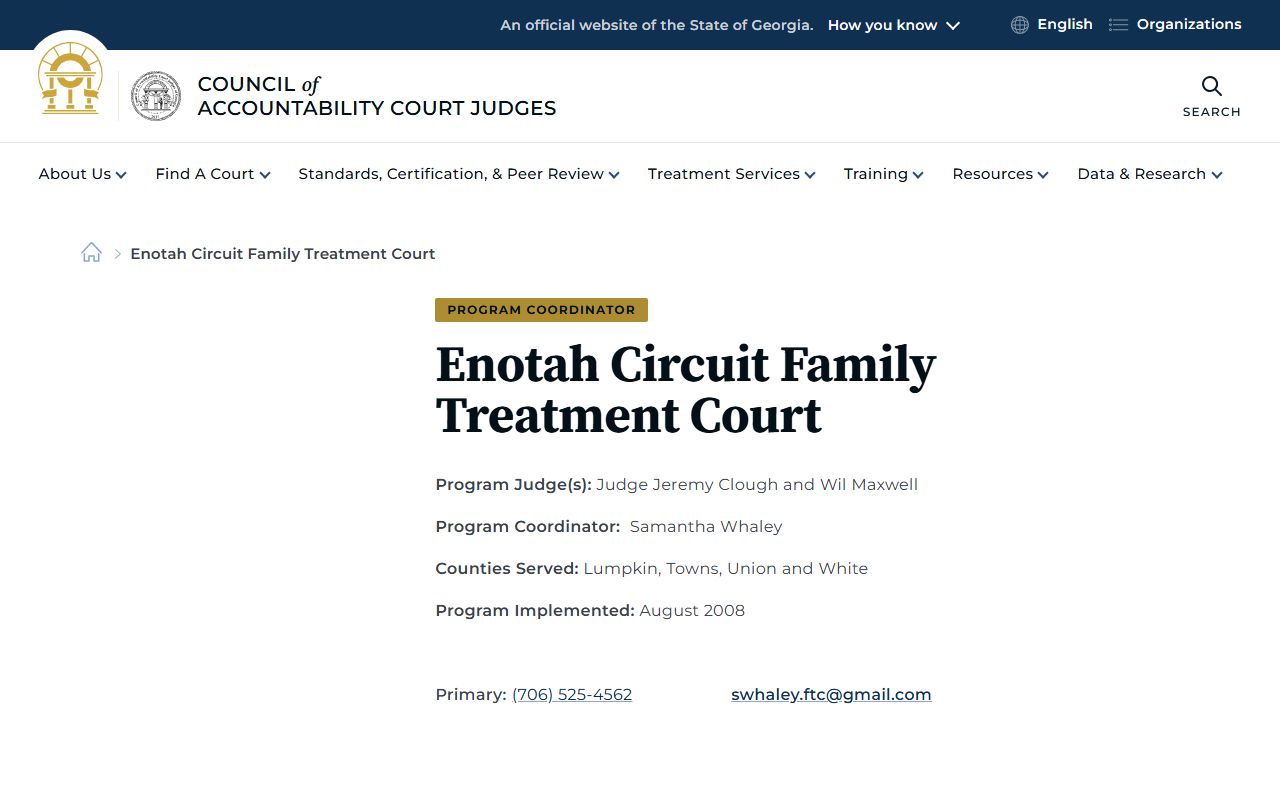
Family Treatment Court is circuit-level, not Towns-only, so eligibility and program details should be confirmed with the court or program staff.
A second accountability-court image comes from Enotah Circuit Mental Health Court.
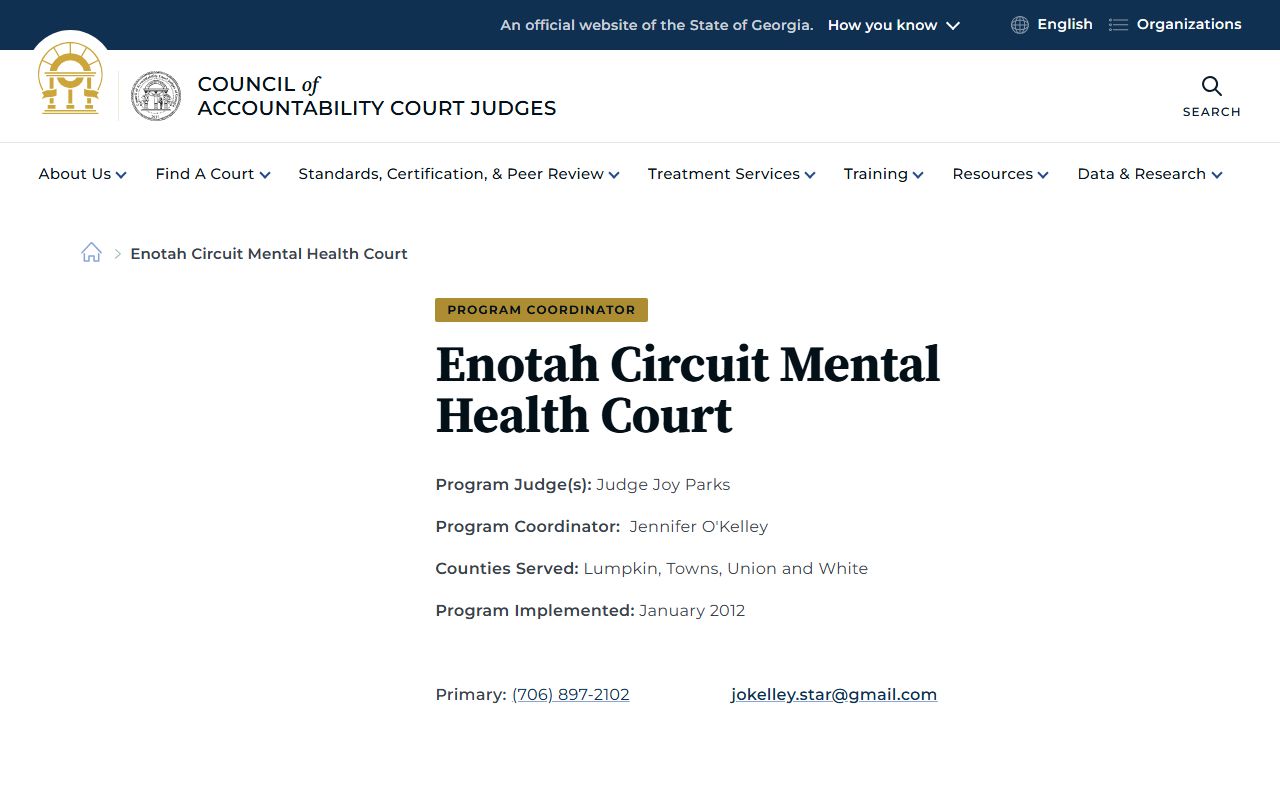
The mental-health court source supports the research finding that some criminal cases may involve circuit-level treatment court review rather than a standard docket path alone.